
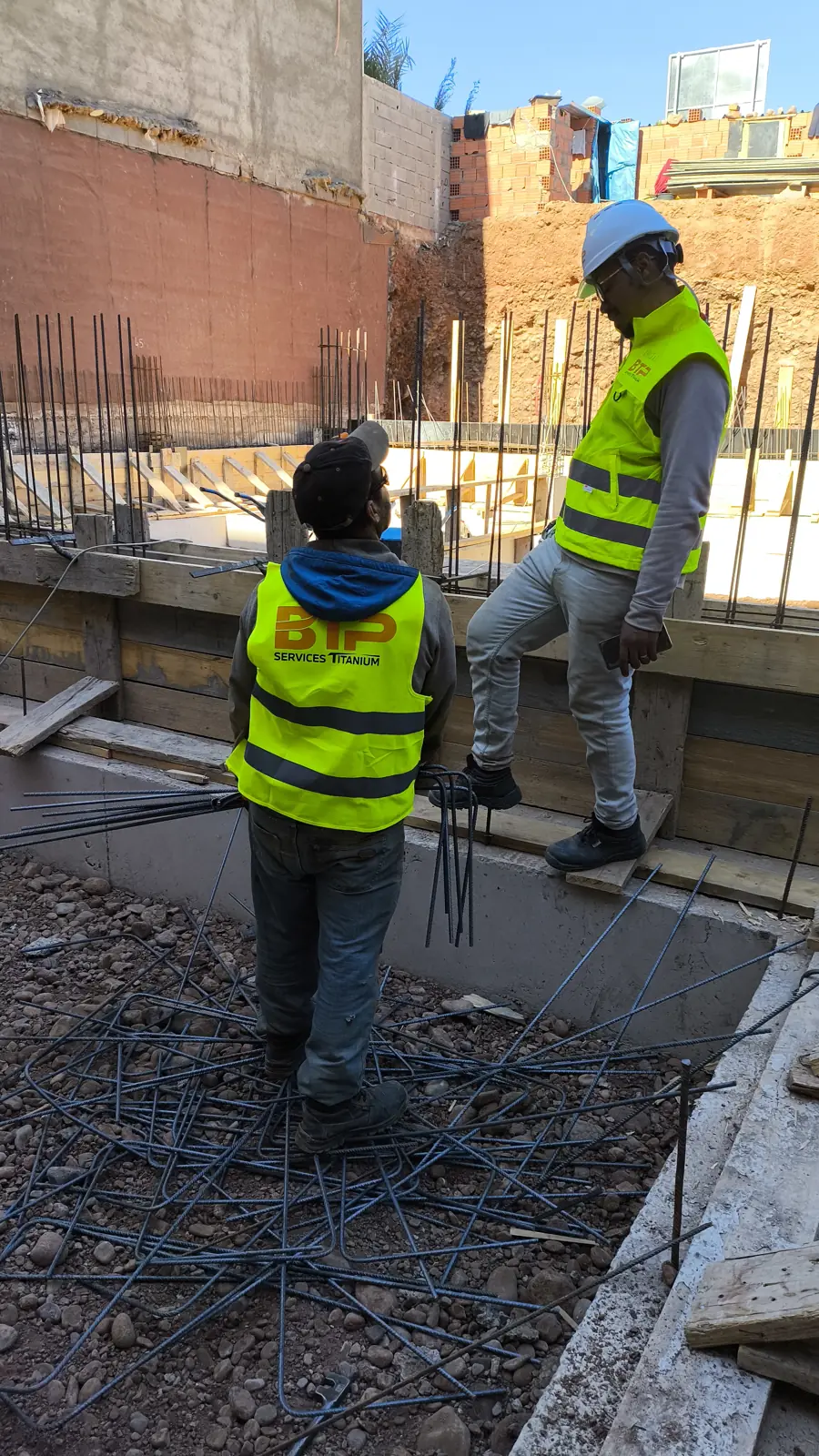
Illustrative data: this sample report does not describe any real property.
Summary
- 300+checkpoints inspected
- 9defects logged
- 4high severity
- 5medium severity
A defect found before handover is fixed by the developer or contractor. Found afterwards, it becomes your problem, and your expense.
Property details
- Property
- Detached two-storey villa with pool (sample)
- Location
- Marrakech
- Area
- ≈ 300 m² living space
- Scope
- Handover inspection before signing the deed / receiving the keys
- Structure
- Visual check of the reinforced concrete and review of the inspection body's records (site reports, final report)
- Standards
- Moroccan RPS seismic standards, good building practice, project documents
- Warranty
- Check of the ten-year structural warranty certificate
Floor plan with defect locations
Tap a marker to open the defect card.
Ground floor
First floor
Defects & findings
F-1 Shrinkage crack around a window frame
What's wrong
Fine, continuous crack in the render around the frame, mostly at the upper corners. The joint between frame and masonry is rigid and has come away in places.
Risk
Air and rainwater getting in at the junction, then damage to the render and to the interior paint.
Required corrective action
Rake out the crack, clean, fill with an elastic façade sealant, patch the render locally, then repaint the whole reveal.
Photo evidence included in the report
F-2 Substructure waterproofing interrupted at a façade corner
What's wrong
At the north-east corner the substructure waterproofing stops below finished ground level. Damp marks and efflorescence at the foot of the inner wall, moisture measured low down.
Risk
Lasting rising damp and water ingress: blistering render, salts, mould and, in time, corrosion of the reinforcement at the foot of the wall.
Required corrective action
Excavate the corner down to the footing, clean the substrate, rebuild the two-coat waterproofing with an overlap onto the existing, add mechanical protection, then backfill. Inspection before backfilling.
Photo evidence included in the report
F-3 Main distribution board unlabelled, RCDs to be checked
What's wrong
No circuit labelling on the board. The test button of one residual current device does not trip. Two stripped conductors left loose in the trunking.
Risk
Protection of people not ensured on part of the circuits, and dangerous work in the event of a fault.
Required corrective action
Replace the faulty 30 mA RCD, insulate and connect the loose conductors, label every circuit, and hand over the board schedule and the electrician's test report.
Photo evidence included in the report
F-4 Insufficient fall and upstand around a terrace outlet
What's wrong
Water keeps ponding around the outlet after a flood test: the fall does not carry water to the drain. The waterproofing upstand is too low at the foot of the parapet.
Risk
Standing water and leaks into the living-room ceiling below.
Required corrective action
Rework the screed fall towards the outlet, raise the waterproofing upstand to the specified height, then run a flood test before the final finish is laid.
Photo evidence included in the report
F-5 Concrete segregation (honeycombing) at the base of a column
What's wrong
Area of coarse aggregate with no cement paste, about 30 × 20 cm at the base of the column, with visible voids: poor vibration or grout loss through the formwork during the pour.
Risk
Insufficient cover to the reinforcement: corrosion of the bars and local loss of strength in a load-bearing element.
Required corrective action
Break out unsound concrete back to sound material, inspect the bars and treat them if needed, then rebuild with a structural repair mortar. Written opinion from the structural engineers if bars are exposed or corroded.
Photo evidence included in the report
F-6 Abnormal water loss from the pool
What's wrong
The bucket test, with filtration off, shows the pool level dropping much faster than the water in the bucket (evaporation). Cracked seal around a return jet.
Risk
Continuous leak: excess water use, saturated ground around the pool and possible settlement of the surrounding paving.
Required corrective action
Commission a leak detection (pressure test of the pipework, dye test on the fittings), reseal the faulty fitting, then repeat a 48-hour level test.
Photo evidence included in the report
F-7 Diagonal façade crack from the corner of an opening
What's wrong
Diagonal crack running from the upper corner of the window, measured up to about 0.3 mm wide, through the render and apparently into the masonry.
Risk
Possible sign of an inadequate lintel or ring beam. Water ingress into the wall.
Required corrective action
Fit tell-tales and monitor the width for several weeks. Stable crack: open up, treat and apply reinforcing mesh before re-rendering. Active crack: structural diagnosis before any repair.
Photo evidence included in the report
F-8 Poor workmanship in a bathroom
What's wrong
Hollow-sounding floor tiles at the shower, incomplete grout joints and a detached silicone seal on the shower tray. Insufficient fall to the drain.
Risk
Water getting under the tiles, loose tiles and water damage to the ceiling below.
Required corrective action
Lift the hollow tiles, check the under-tile waterproofing, correct the fall and re-lay with full adhesive coverage, then redo the grout and silicone seal.
Photo evidence included in the report
F-9 Poorly built pool: construction joints, copings and deck not compliant
What's wrong
Cracks along the construction joints between the pool floor and walls, with no visible waterstop. Uneven copings and a deck that falls back towards the pool. No visible equipotential bonding on the metal fittings.
Risk
Water ingress through the pool structure and corrosion of the reinforcement. Dirty surface water running into the pool. Electrical risk for swimmers.
Required corrective action
Drain the pool and have the structural engineers carry out a diagnosis. Treat the joints according to their findings (resin injection or new internal waterproofing). Relay the copings and rework the deck falls away from the pool. Install equipotential bonding and have it checked by an electrician.
Photo evidence included in the report